

Football Fitness Without the Pads
A Game-Day Workout for Speed, Power and Conditioning
There are two ways you can approach a football-themed workout. One is where you can put on eye black, puff up your lungs for the ‘fourth quarter!” and annoy everyone near the cable machine. The second one is to simply borrow the genuinely useful bits of football: short bursts of speed, explosive force, hard stops, changes of direction and enough conditioning to do it again. We are going with the second one.
You are not training for an NFL roster. That is good news for your calendar and probably your knees. Why? Because professional players train around position, practices, collisions, injuries and years of technical coaching.
However, your job is simpler. You take the athletic qualities, scale them to your ability and leave the gym feeling sharper rather than ‘medically interesting’.
First, What Are We Actually Training?
We know that football asks for strength, power, acceleration, agility and repeated effort. Here’s a simple breakdown to understand better:
- Strength produces force
- Power produces it (i.e., force) quickly
- Acceleration gets you moving over a short distance
- Agility is the less glamorous skill of stopping yourself before going somewhere else
- Conditioning means the fifth hard effort still vaguely resembles the first (i.e., you can exert nearly as much on the fifth try as you did on the first, or at least, the second)
A 2025 Journal of Strength and Conditioning Research study in American football players looked at speed, change of direction and momentum together. The takeaway for normal humans is that athleticism was not a magic number. As a result, a decent football-inspired session should do more than make you run through twelve cones arranged like modern art.
Warm Up Before You Suddenly Remember You Are Explosive
You should be spending eight to ten minutes to go from ‘sat in a car’ to ‘ready to move quickly.’ One of the best ways to do so is with easy cardio. It must include movement of the ankles, hips and upper back. Moreover, you can add squats, reverse lunges, marches and skips to get the blood pumping. If you have turf, do a couple of gradual accelerations.
- Get warm before getting fast
- Rehearse the positions you will use
- Increase intensity in steps, but not with a heroic first rep
If a movement feels unstable during the warm-up, believe the information. Don’t exert yourself, it’s only the warm up. You can try swapping the jump for a medicine-ball throw, or the sprint for a sled push or bike effort. The main reason behind that is that football players adapt constantly, so you’re allowed to do the same without losing the theme.
Power: Three Good Jumps Beat Ten Bad Ones
Now, you should pick one explosive exercise. Do three to four sets of three to five repetitions, which can be squat jumps or box jumps (great options if you already jump comfortably). A medicine-ball chest pass or scoop toss is excellent, as well, if impact is not your friend. If you’re unsure, try fast sit-to-stands that work surprisingly well for beginners.
A 2025 plyometric training review found improvements in jumping, sprinting and change-of-direction performance. This does not mean you should keep jumping until gravity wins. Put simply, power is about speed and intent. When landings get noisy or you feel that a committee meeting might be upcoming between reps, stop the set.
Strength: The Unflashy Bit That Makes Everything Else Better
Choose two big movements and perform three sets of five to eight repetitions. A goblet squat, trap-bar deadlift or leg press can handle the lower body. Then, you can pair that with an upper-body press or row. Try using a weight that makes you concentrate but does not turn the final rep into interpretive dance.
It’s important to mention that there is no reason to max out. You are training, not trying out. With solid strength, you can acquire a base for the faster exercises a base. Eventually, it will make the workout useful long after football month is over.
Acceleration: Short, Sharp and Fully Recovered
If you can sprint safely and have turf, perform four to six accelerations over about 10 to 20 yards. Then, walk back, and breathe. Go again when you are ready to be fast rather than merely tired. To help, think strong lean and quick forceful steps rather than frantic feet, which is a common beginner mistake.
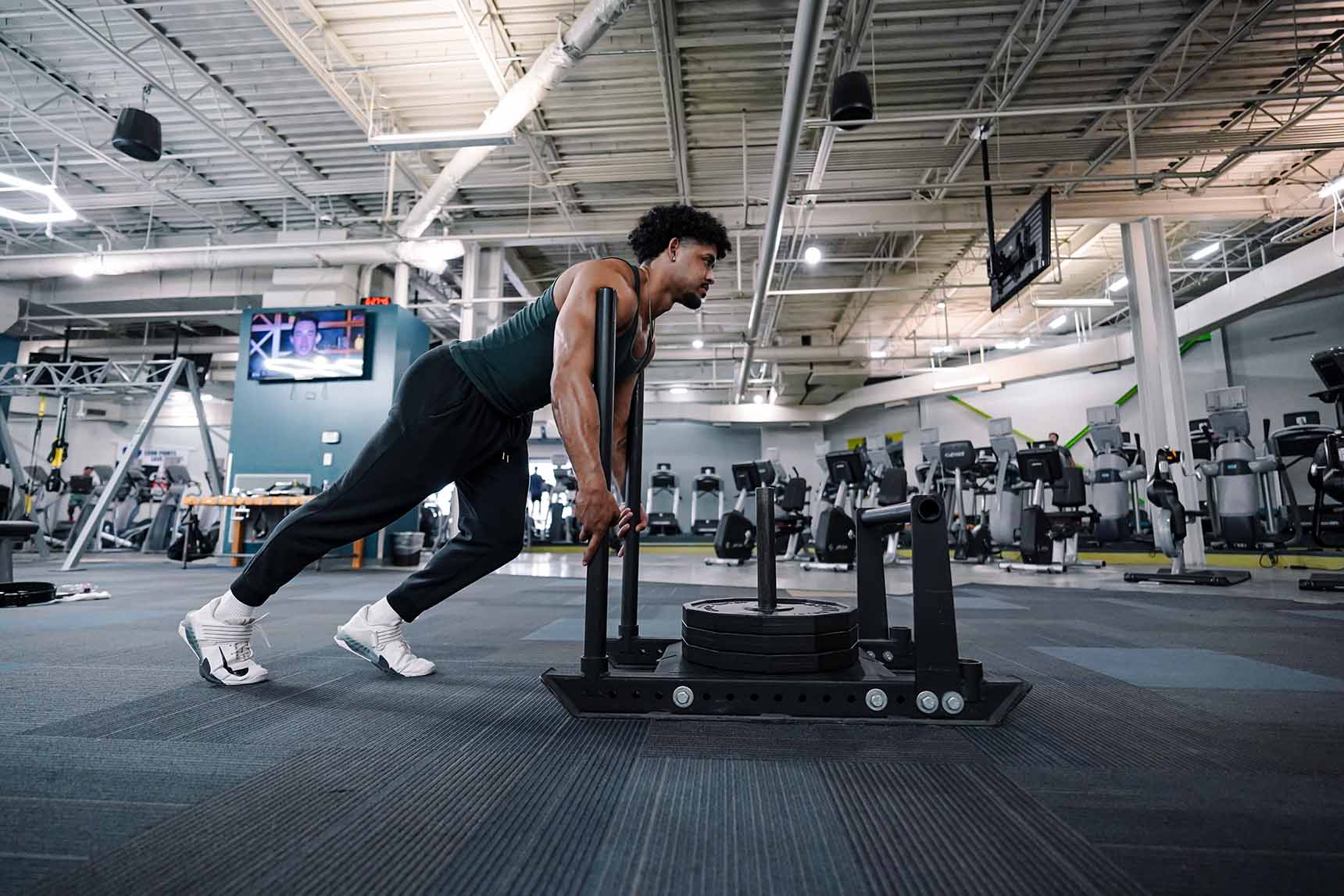
A light sled is a brilliant alternative, In fact, a 2025 resisted-sled training review reported improvements in short-distance sprint performance in team-sport athletes, especially over the early meters. Pushing a sled also has the pleasing simplicity of moving a heavy thing from here to there without having to remember choreography.
Agility: Learn to Stop Before You Learn to Look Quick
This is where you can put markers to use. Put two markers a few yards apart. Shuffle, cut or move forward and backward for three to five rounds. You should begin at a speed you can control. Then practice in the following sequence: brake, plant, go.
There’s a 2026 agility training review that found meaningful improvements in reactive agility among team-sport players. However, your version does not need flashing lights or an assistant coach with a whistle. We recommend focusing on clean deceleration.
With that, here’s a proper breakdown to give you an idea:
- Power – 3-4 sets of 3-5 crisp reps
- Strength – two big exercises, 3 sets of 5-8
- Speed and cuts – short efforts, proper recovery, no sloppy heroics
Finish Like a Football Drive, And Not a Punishment Session
On a bike, rower, sled or battle ropes, do six to eight rounds of 15 seconds hard and 45 seconds easy. If you decide to rest, which is recommended, don’t consider it cheating. It is a healthy and effective way to let you repeat a decent burst instead of producing one excellent interval followed by seven increasingly philosophical ones.
It is always recommended that you stop explosive work when technique falls away. If you have a recent injury, joint problem, cardiovascular concern or very little high-intensity experience, you can scale your session and get appropriate guidance. Remember, your joints are unimpressed by seasonal marketing.
Now, how fast should the fast bits be? Fast enough that they feel different from ordinary training, but not so fast that you spend the next ten seconds wondering where your feet went. Think about leaving each rep with the sense that you could have done slightly more. If it helps, you can view the resting interval as a boring pause that allows you the next fast rep actually be fast.
Conclusion
You should keep in mind that football fitness is not cosplay and that training can be athletic and playful. The focus is to work hard, recover and do another good rep. You probably will not hear a stadium roar when you finish, but that shouldn’t discourage you (or incentivize you). You may, however, walk out feeling quicker, stronger and considerably less bored, which is a perfectly respectable game-day result.
Ready to Build Your Game Plan?
A Genesis personal trainer can help you assess your current fitness level, choose the right exercises and create a plan around your goals. Get started with a complimentary personal fitness assessment.